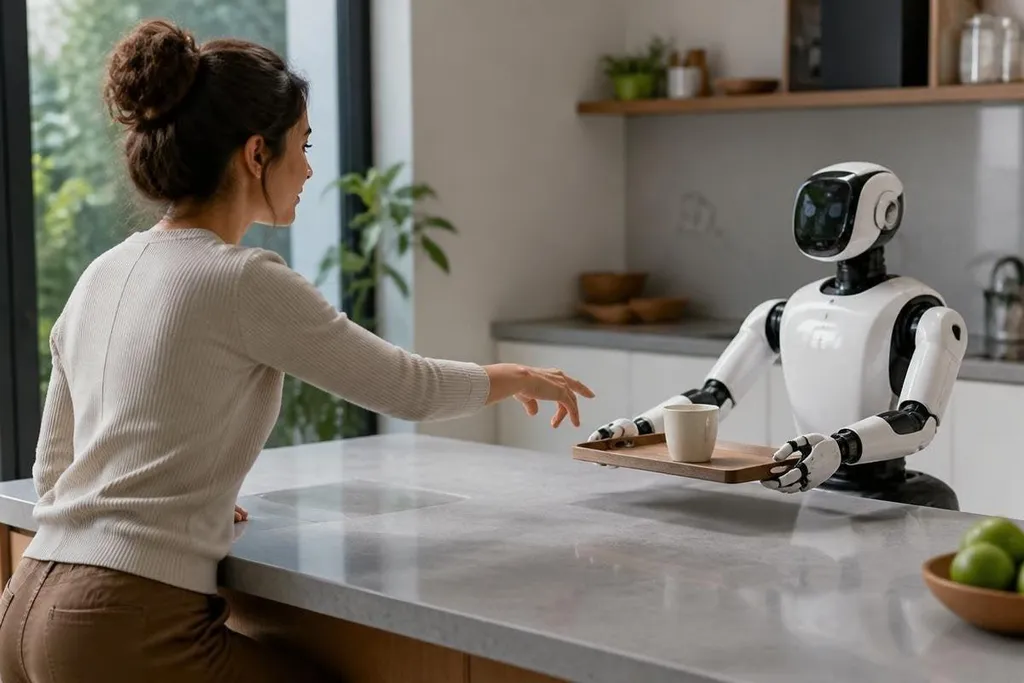
A robot can detect that you reached toward a cup. It still has to work out whether you want the cup moved, filled, or left alone. That gap explains why human intent remains hard for autonomous systems.
- Intent comes from several signals, not one command.
- Context helps separate a request from a warning.
- Clear limits matter more than a confident guess.
What a robot is trying to infer
Human intent is the goal behind an action. Your hand movement is an action; getting a drink is the goal. The system has to connect the two without seeing every step inside your head.
It may use speech, body movement, gaze, object position, and the task already underway. A camera can track where you look. A microphone can detect a spoken request. Force sensors can show that you are pulling an object instead of handing it over.
Each signal removes some doubt, but none gives a full answer on its own. A raised hand could mean “stop,” “come here,” or a greeting. The robot needs the room, the people, and the current task to choose a response.
That context is often stored as a task model. The model lists the goal, the objects involved, the actions allowed, and the conditions that should stop the robot. It gives the robot something to compare with what it sees and hears.
How intent recognition works
The robot first collects signals from its sensors and software. A language model may turn spoken words into a likely goal, while a vision system checks if the scene matches those words.
A planning system then selects an action that fits the goal and the robot’s limits. This process is a chain of guesses, checks, and actions. If you say, “Put that on the table,” the robot must identify “that,” find the table, plan a safe path, and check the object after the move.
The last check matters. Speech can be unclear, a camera can lose sight of an object, and a person can change their mind. A system that asks for confirmation at the right point may work better than one that acts on every guess.
The weak point is the handoff from a guess to an action. Reports on robots reading human intent can give you named systems and test settings to compare before the next section shows where that handoff fails.
Where the method breaks
Intent recognition gets harder when the task has no fixed goal. A service robot in a home may see a person point toward a shelf, but the shelf could hold several objects. The robot may need a question before it moves.
People also give mixed signals. Someone can say “leave it” while reaching for the object. A safe system should give more weight to an explicit stop command than to a weak motion cue, especially near a moving arm or gripper.
Training data creates another limit. A model learns patterns from recorded examples, so it may handle common gestures and speech better than unfamiliar ones. That can affect people who use different words, movements, or communication methods.
The robot also needs a way to show uncertainty. A pause, a spoken question, or a visible request for confirmation gives you a chance to correct it. A silent action based on a poor guess is harder to spot and harder to stop.
What to check before you buy or deploy
Intent recognition sounds useful only when the system’s limits match the job. Check these points before a trial:
- Name the goal: Write down the exact tasks the robot must complete, including the objects and people involved.
- List the signals: Check if the system uses speech, cameras, touch, gaze, or another input for each task.
- Test unclear requests: Try missing names, pointing, interruptions, and two possible objects in the same scene.
- Check the stop path: Confirm how a person stops the robot and how long the system takes to halt.
- Measure the handoff: Record when the robot asks a question, waits for approval, or gives control back to a person.
These checks turn a broad claim into a job-specific test. One system may read intent well in a fixed station and poorly in a busy room, so the setting belongs in the trial plan.
I’d trust intent recognition first in tasks with clear objects, fixed steps, and an easy human stop. Open-ended work needs more questions, more checks, and a person ready to correct the plan.
The useful question for any deployment is narrow: what evidence must the robot see before it acts, and what does it do when that evidence conflicts?